
The limits to EPB
Brussels, October 2024

version

version (press)
Reducing greenhouse gas emissions has become a major collective challenge. Against this backdrop, the EU adopted directives that led, among other things, to the EPB certificate (Energy Performance of Building)1, making it the be-all and end-all of environmental policy for buildings. We argue that this idea puts the focus in the wrong place; that in doing so it overshoots both environmental and social goals; and that it even harms the economy and the landscape.
Theory versus reality: does the EPB certificate influence consumption? ↑

The graph above says a lot about the weakness of the current strategy. It comes from a study conducted a decade ago in nearly 50 000 homes in Amsterdam and compares actual consumption with theoretical consumption in relation to the building’s EPB category 2. The figures are damning: while actual consumption should drop dramatically as the building’s EPB score rises from G to A, instead we see that actual consumption remains at a relatively constant level. The conclusion is problematic: progress towards a better EPB score does not automatically lead to lower consumption. These results have since been confirmed by other research, including a recent study conducted in the Brussels Region, in collaboration with KULeuven and VUB3. It is time to take these conclusions seriously.
The discrepancy between theoretical and actual consumption can have several causes, including the fact that models underestimate the actual performance of older buildings by inadvertently using assumptions that are unfavourable to them. But much of the discrepancy between theoretical and actual consumption is due to the ability of occupants to take action. Because one fact is certain: once a building is built, it does not consume energy. Its physical composition does affect the rate at which energy is dissipated, but it does not drive this consumption. Use, on the other hand, does play a major role: Do I leave the windows open in winter? Do I set the thermostat to 23°C or 17°C? Should I heat only when I am present, in the rooms I use, or everywhere all the time? etc. A significant part of the difference between theoretical and actual consumption is due to the attention of occupants and the configuration of their homes 4.
By not taking residents into account, the current policy effectively gives us a blank cheque: as long as we insulate, we can consume generously while getting subsidies. And that is exactly what we are doing, as several studies on the rebound effects of insulation demonstrate 5.

As a reminder, the ecological challenge is to reduce the sum of our consumption, and to do it in the real world rather than in theory. The success or failure of our collective action will be determined by the numbers on the meter. In this respect, insulation is certainly not the only or ultimate solution, and the EPB label even less so.
Is [kWh/m2] the relevant unit for political action ? ↑
So in absolute terms, the theoretical [kWh/m²] given in the EPB certificate is not a good representation of actual [kWh/m²] consumption. But is this unit [kWh/m2], used to assign labels, a good measurement tool? The answer to this question requires two additional comments.
1/ The unit [kWh/m²] does not take into account the size of the dwelling, so the total energy used does not count either. A large villa and a small flat are assessed on the same basis, even though the volume to be heated is very different and so the impact of one and the other is totally different. A small flat with low EPB performance is just as energy efficient as a more efficient but more spacious house.

2/ [kWh/m²] also leaves out the number of users for which the energy is consumed. However, we can intuitively see the savings or wastes associated with low or high occupancy density. Two people heating a large, well-insulated flat, on an individual basis, have a footprint equal to that of the members of a family of six occupying the same flat, which is three times worse in EPB terms.

Consequently, the system based on the theoretical unit [kWh/m²]6, around which subsidies and future fines revolve, is thus not only a system that bears little relation to actual consumption. It is also a system that is fundamentally unfavourable to those who, because they live with many and/or in small homes, contribute at least as much to reducing greenhouse gas emissions. Leaving aside the ecological aberration it represents, who dares claim that such a policy is socially responsible?
By relying on the theoretical [kWh/m²], those responsible for the EPB framework assumed they were choosing the least bad indicator to qualify a potential performance; however, this does not mean that this indicator is suitable as a basis for policy.
What about the impact on resources ? ↑
We saw how little ecological gain can be expected from moving from one EPB category to another. It may even be negative in some cases, considering that this jump requires use of resources and materials. Life cycle analysis, as it is starting to be used today (Nibe, Totem, etc.), tries to take these effects into account by setting the potential energy savings of the building site against the environmental costs and lifetime of the materials; however, the models overestimate the energy gains after renovation and probably underestimate the actual footprint of the building site.
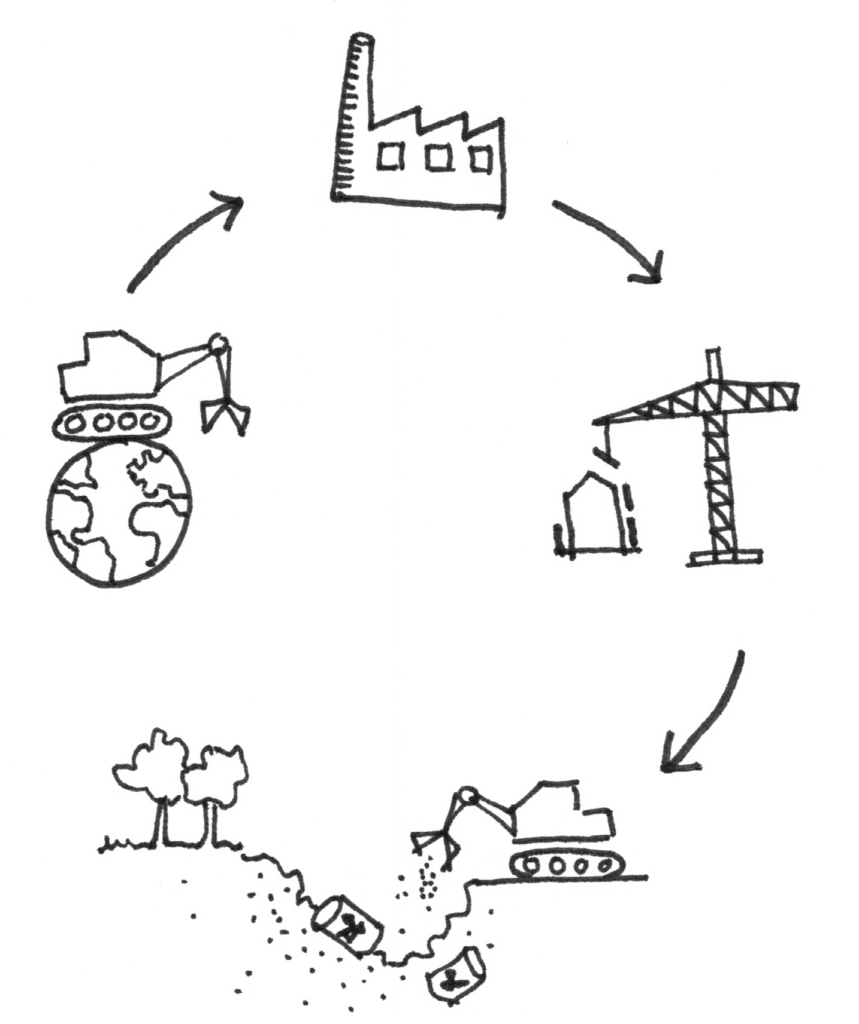
An imposed ‘energy renovation ’ in all possible directions, which is neither the only nor the best option, might well be a productivist and extractivist imperative that does more harm than good to the environment.
Social consequences ? ↑
Associations involved in the right to decent housing warn that the current strategy is a social time bomb if not revised7. The EPB category plays such a role that it encourages landlords to renovate poorly insulated homes and raise rents, without this increase being fully offset by a reduction in charges. One of the arguments of EPB proponents is that the work is worthwhile because it saves energy and thus money, offsetting the cost of the investment or the rent increase. But while it may seem logical to scientists in laboratories, or to the politicians who listen to them, the idea of a ‘warm rent’ (rent + heating costs) that would remain constant has not been demonstrated in practice: to work, this fictitious idea assumes significant initial consumption, which in reality is often overestimated, especially for poorer households; we are thus dealing with a policy that vastly overestimates the scope for improvement for low-income households, and thus their potential financial benefit, just as it overestimates the real ecological benefits. The shock of a rent increase (for modest renters) or a loan repayment (for modest homeowners) will simply not be absorbed 8.

This is all the more worrying because it is accompanied by unfavourable statistics: the EPB classes of buildings often overlap with the social classes of the people living in them. Categories F and G are the first targets of the EPB instrument; residents of modest means are the ones who, instead of benefiting from it, and despite all good intentions, will be the first victims.
Economic logic ? ↑
As cited above, the forced ‘upgrading’ of the least isolated part of the housing stock means de facto a significant reduction in the supply of accessible housing, for environmental gains that remain uncertain to say the least. More generally, the government does not have the resources to fulfil its housing ambitions: the construction and renovation of social housing is already not keeping pace with demand, far from it.9 In this context, an increasingly restrictive policy towards landlords sends problematic signals to private investors, which we cannot do without in the current situation. After all, how can we not worry about a decline in investment, and consequently in the supply of rental housing in the medium term, at a time when the conditions for access to housing are becoming increasingly difficult for most applicants?

It is not a matter of calling for complete deregulation, it is a matter of measuring and rationalising the proposed regulations and in particular the EPB requirements, which mechanically accelerate the rise in rents. Let us combat dilapidation, and encourage roof insulation and renovation of the oldest heating systems: these actions are both sensible and necessary, and are in themselves a huge challenge on which to focus. Apart from that, there is no such thing as free renovation, and no, it does not pay for itself. Defending the supply of decent, affordable housing means fine-tuning the requirements we apply to it, otherwise we risk it disappears 10.
And the historic perspective ? ↑
In the 1960s and 1970s, people wanted to modernise the city. In fact, past and future were contrasted and the former was sacrificed in favour of the latter. As a result of “Bruxellisation”, some neighbourhoods lost their human character. Today, the new mantra is: isolate by any means necessary, at any cost, or almost. This will have aesthetic implications for our old buildings and our urban landscapes, the fruit of a certain historical sedimentation. And it could also have an effect on the physical performance of these buildings, a physical performance towards which our vision is often naïve. It is true that adding a layer when you are cold helps, but insulating a wall is not the same as insulating a roof or replacing a window frame. In each case, different techniques apply and mastering them – to put it mildly – is not taught systematically and can quickly lead to moisture problems.
Conclusion ↑
The implementation of a policy with such mediocre collective results should be questioned. What is the point of a policy that pays more attention to insulating buildings than it ever gave to making them healthy? A damp house will never be comfortable unless it is thoroughly heated, while a dry house can remain comfortable even at fairly low temperatures.
Energy is a common good. Saving it together is both an ecological duty and a matter of social justice. But this struggle must be effective and consider both feasibility and the impact on the most vulnerable. Contrary to stated ambitions, there is a lack of consistency in the rules imposed on buildings to reduce greenhouse gas emissions. We call for an open debate on the relevance of the European strategy focused on the EPB concept, and how this should be transposed into regional legislation.

~~~~##~~~~
Notes & References ↑
- EPB : Energy Performance of Building (NL & EN), PEB : Performance Énergétique du bâtiment (FR-BE), DPE : Diagnostic de Performance Énergétique (FR-FR). ↩︎
- Relatie tussen energielabel, werkelijk energiegebruik en CO2-uitstoot van Amsterdamse corporatiewoningen, Delft University of Technology, Majcen, D., & Itard, LCM., 2014 ↩︎
- Faut-il valoriser les consommations réelles face au calcul théorique de la PEB ?, Maison de quartier Bonnevie, Atelier Moneo, Kennis Centrum WWZ, KU Leuven, VUB, Renovasssistance, Rotor, 2022 ↩︎
- Refers to Claude Lefrançois’ work and the Slowheat research, which both highlight, in their own way, the interest in behaviors, ways of living, and arrangements which are not necessarily promoted by the EPB but will help to reduce consumption. ↩︎
- For exemple :
– Rebound Effects for Household Energy Services in the UK, M. CHITNIS, R. FOUQUET, S. SORRELL, The Energy Journal, 2020
– Assessing the effectiveness of energy efficiency measures in the residential sector gas consumption through dynamic treatment effects: Evidence from England and Wales, Energy Economics, C. PENASCO, L. DIAZ ANADON, 2023
– Daten und Trends der Wohnungs- und Immobilienwirtschaft,
presentation support for the annual press conference of Die Wohnungswirtschaft in Deutschland, 2020. ↩︎ - These tables, expressed in theoretical [kWh], remain within the limits of EPB modelling and do not take into account the influence that, for example, differences in indoor temperatures between dwellings may have on actual consumption ↩︎
- Enjeux sociaux et économiques de la Renolution énergétique du bâti bruxellois, this concern emerged quite clearly from the discussions of the associative assembly that Inter-Environnement Brussels organized on October 24, 2023. ↩︎
- Obligations in the existing housing stock : who pays the bill ?, B. Daniëls, C. Tigchelaar, M. Menkveld, ECEEE 2011 SUMMER STUDY, 2011 ↩︎
- 55,000 households on the waiting list with an average wait of 10 to 15 years according to the RBDH ↩︎
- Crise du logement : la Wallonie touchée par le manque d’offres face à la demande, RTBF-Info, BELGA, 6/09/24,
Zelfs mensen met ruim budget vinden geen huis: 35 procent minder huurcontracten door gebrek aan huurwoningen, S. Schoofs, VRT, 6/09/2024 ↩︎